
For years, commercial coffee shop design was dominated by cold, sterile aesthetics—stark white walls, exposed industrial steel, and hard concrete that felt more like a laboratory than a sanctuary. While sleek, minimalist spaces photograph well, they often fail to make customers want to sit, linger, and savor their morning brew.
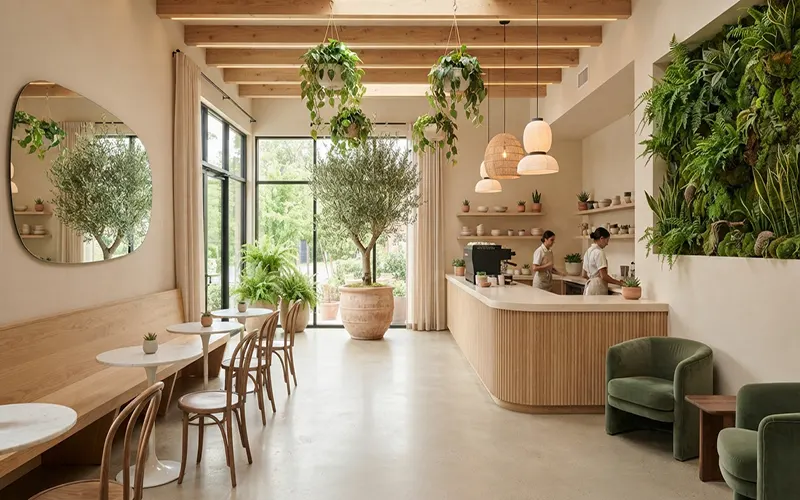
The modern hospitality landscape has evolved. Today’s cafe-goers crave spaces that feel restorative, grounded, and emotionally welcoming. The secret lies in a powerful design synthesis: marrying the clean, uncluttered lines of modern minimalism with the organic, living warmth of biophilic design. Here is how to design a cafe interior that balances architectural simplicity with natural soul.
The Philosophy of Warm Minimalism in Hospitality
True minimalism is not about stripping a space of its personality or making it feel uncomfortable; it is about intentional editing.
- The Shift from Cold to Warm: Clinical minimalism relies on high-contrast blacks, bright whites, and shiny surfaces that amplify noise and bounce harsh light. Warm minimalism, on the other hand, embraces architectural restraint while focusing heavily on tactile richness, natural light, and earthy imperfection.
- The Customer Experience: When a cafe is visually uncluttered, the human brain instantly relaxes. Adding biophilic warmth softens that structure, creating an oasis of calm amid the chaos of urban life.
Strategy 1: Materiality and Organic Textures
In a minimalist layout where ornamentation is kept to a minimum, your materials are your decoration. Every surface must invite touch.
- Raw Meets Refined: Pair smooth, matte microcement or lime-washed walls with honey-toned reclaimed wood or fluted timber paneling. The contrast between industrial smoothness and organic grain creates immediate visual depth.
- Natural Stone Countertops: Opt for soapstone, honed travertine, or terrazzo for your espresso bar. Unlike polished granite, honed and leathered natural stone surfaces have a soft, organic texture that patinas beautifully over time with heavy customer use.
Strategy 2: Strategic Biophilic Integration
Biophilia is the innate human tendency to seek connections with nature. However, in a compact cafe, you want to avoid turning your seating area into an overgrown jungle.
- Statement Living Elements: Instead of cluttering tables with tiny pots, install a cascading wall of trailing pothos or philodendrons along a high perimeter shelf, or build a sleek moss accent wall behind the banquette.
- Indoor Trees: Anchor a corner of the cafe with a large, sculptural indoor tree—such as an olive tree, Ficus lyrata, or a multi-stemmed birch—planted in a minimalist matte ceramic vessel. It draws the eye upward and instantly softens the room’s hard geometric angles.
Strategy 3: Lighting as a Natural Rhythm
Lighting dictates the emotional frequency of your cafe. To maintain a minimalist framework while fostering warmth, lighting must be layered and organic.
- Maximizing Daylight: Keep window treatments minimal or nonexistent to flood the space with natural daylight, which energizes morning commuters.
- Warm Color Temperatures: Ensure all interior bulbs sit in the warm range (2700K). Use recessed perimeter wall-washes to create a soft halo effect rather than harsh downward spotlights.
- Organic Fixtures: Hang pendant lights crafted from woven rattan, rice paper, Japanese linen, or hand-thrown ceramic. These materials diffuse light softly and act as sculptural art pieces during daytime hours.
Strategy 4: Earthy Color Palettes and Acoustic Softness
Color and sound dictate whether a minimalist room feels peaceful or echoing and hollow.
- The Grounding Palette: Build your color story around nature’s neutral spectrum: warm taupes, soft sage greens, terracotta, clay, oatmeal, and sandy beige.
- Solving Acoustic Challenges: Minimalist spaces are notorious for hard surfaces bouncing noise. Integrate acoustic wood-slat wall panels or upholstered banquette seating wrapped in tactile boucle or linen fabrics. This absorbs ambient espresso machine noise while keeping the clean-line aesthetic intact.
Strategy 5: Furniture and Spatial Flow
Every piece of furniture in a warm minimalist cafe must serve both an aesthetic and ergonomic purpose.
- Low-Profile Timber Seating: Choose chairs and stools crafted from solid oak or ash with curved, organic silhouettes that echo human forms, contrasting sharply against rigid rectangular tables.
- Preserving Sightlines: Keep furniture layouts open and low-slung. Unobstructed sightlines across the room make a small or medium-sized cafe feel expansive, breathable, and serene.
Merging modern minimalism with warm biophilic elements creates a powerful design paradox: a space that feels utterly uncluttered yet profoundly alive. By focusing on tactile natural materials, organic lighting, earthy tones, and living greenery, you craft a soulful hospitality environment that draws customers in, invites them to linger, and keeps them coming back.