
In the realm of real estate investing and homeownership, wealth is rarely built by luck alone. While paying down your mortgage principal builds equity over time, true exponential wealth is captured through market appreciation—the natural upward trajectory of a property’s market value.
However, not all properties appreciate at the same rate. Why do homes in one neighborhood double in value over a decade while properties just a few miles away stagnate? Understanding the core economic, geographic, and structural forces that drive residential appreciation is the ultimate key to selecting winning properties that outperform the broader market.
Factor 1: Macro-Economic Fundamentals and Job Growth
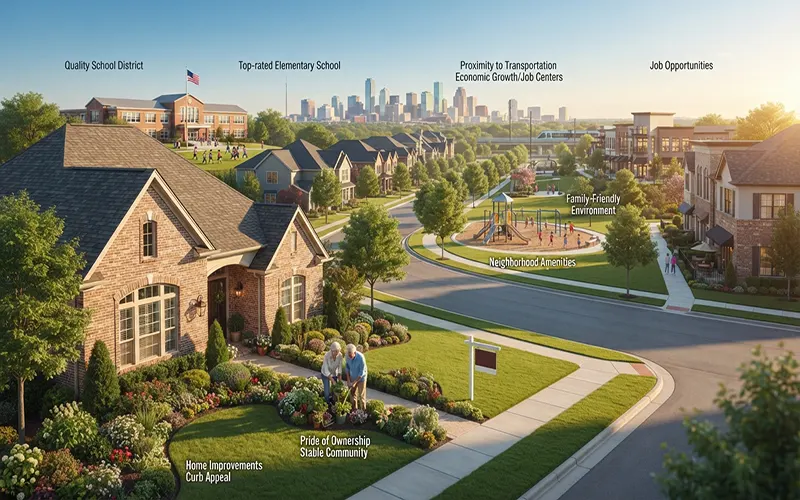
At the foundational level, real estate values follow employment. If people are moving to an area, they need a place to live, which creates sustained housing demand.
- Corporate Relocations and Tech Hubs: Watch where major employers expand or relocate. Cities experiencing influxes of tech campuses, corporate headquarters, or healthcare manufacturing clusters attract high-earning professionals who drive up both housing prices and rental rates.
- Diversified Local Economies: Markets dependent on a single industry are vulnerable to economic shocks. The most resilient, fast-appreciating regions boast diversified economies blending technology, finance, higher education, and government sectors.
- Median Income Growth: Rising median household incomes directly correlate with increased buying power, allowing families to qualify for larger mortgages and bidding up local home values.
Factor 2: School Districts and Educational Quality
Even if a homebuyer does not have children, the quality of the local school district is one of the most recession-resistant value drivers in residential real estate.
- The Educational Premium: Families will consistently pay a heavy financial premium to live within the boundaries of top-tier public school districts or near prestigious universities.
- Liquidity and Market Stability: During economic downturns, homes in elite school districts hold their value far better than those in lower-performing areas. When the market recovers, they are typically the first properties to appreciate aggressively because demand never truly dries up.
Factor 3: Infrastructure Development and Transit Access
Real estate appreciation often follows the path of public and private infrastructure investment. Buying ahead of planned transit upgrades is a classic wealth-building strategy.
- Transit-Oriented Development: The announcement and construction of light rail systems, subway extensions, commuter rail links, or major highway expansions instantly transform the accessibility of previously overlooked neighborhoods.
- Urban Revitalization: City-backed investments in downtown parks, waterfront boardwalks, cultural centers, and pedestrian corridors signal that a neighborhood is transitioning into a high-demand lifestyle zone.
Factor 4: Supply Constraints and Zoning Laws
Basic economics dictates that when demand rises and supply remains restricted, prices must go up.
- Geographic Barriers: Cities bounded by natural barriers—such as oceans, lakes, mountains, or protected state parks—cannot sprawl outward infinitely. These geographic constraints create a natural scarcity of buildable land.
- Strict Municipal Zoning: Cities with restrictive residential zoning laws (such as strict single-family zoning or slow bureaucratic approval processes for new multi-family builds) limit new inventory. This artificial scarcity protects existing homeowners and accelerates long-term appreciation.
Factor 5: Neighborhood Walkability and Amenity Density
Modern homebuyer preferences have shifted dramatically away from isolated subdivisions toward connected, walkable communities.
- The “15-Minute City” Concept: Neighborhoods where residents can walk or bike to grocery stores, artisanal cafes, fitness studios, green spaces, and dining options command massive value premiums.
- Community Placemaking: Master-planned communities that intentionally integrate community pools, walking trails, and commercial town centers foster a strong sense of place that attracts high-end buyers and renters alike.
Factor 6: Strategic Property Improvements and Upgrades
While macro-factors govern location-driven appreciation, homeowners have direct control over forced appreciation through targeted property upgrades.
- High-ROI Renovations: Updating outdated kitchens, modernizing primary bathrooms, finishing basements, and enhancing energy efficiency (such as solar integration or high-grade insulation) directly increases a home’s appraised equity.
- Curb Appeal and Structural Integrity: Maintaining a modern roof, a dry foundation, and contemporary exterior styling ensures your property matches or exceeds the appreciation baseline of your surrounding neighborhood.
While you can never change a property’s geographic location, you can choose where to buy by analyzing the macro-economic indicators that drive long-term growth. By identifying robust job markets, stellar school districts, infrastructure expansions, and supply-constrained neighborhoods, you position your real estate portfolio for powerful, reliable value appreciation over time.