
Few winter emergencies are as immediately damaging and costly as a burst pipe. While pipes everywhere in the home are vulnerable to freezing, those running through unheated or poorly insulated spaces, like basements, crawl spaces, and exterior walls, are particularly at risk. Implementing effective winter home maintenance tips for preventing frozen pipes in basements is essential for protecting your property and avoiding thousands of dollars in water damage repairs.
🌡️ Insulating the Vulnerable Zone
Preventing heat loss around your pipes is the first line of defense against freezing.
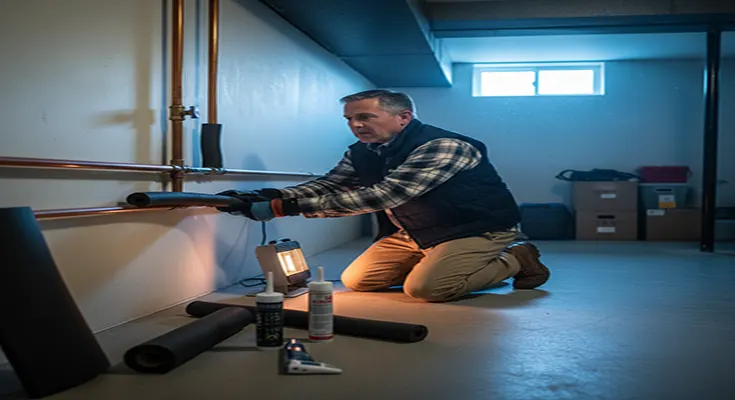
- Insulate Exposed Pipes: Pipes running along exterior walls, near basement windows, or close to the main sill plate are prime targets. Use foam pipe insulation (often called pipe sleeves or pipe wrap) which is inexpensive and easy to install. Cover every exposed inch of pipe you can access.
- Seal Air Leaks: Drafts from the outside are the primary cause of sudden pipe freezing. Inspect your basement thoroughly for any gaps or cracks near the foundation, around cable/wire entry points, and at the sill plate (where the wall meets the foundation).
- Action: Use caulk to seal small cracks and expanding spray foam for larger holes. Ensuring the basement is airtight cuts down on cold air pockets.
- Insulate Basement Walls: If your basement is unfinished, consider adding rigid foam insulation to the inner side of the rim joists and exterior walls. This raises the ambient temperature of the entire basement space, providing a warmer environment for the pipes.
🔥 Active Heat and Circulation Strategies
Sometimes insulation isn’t enough; you need to introduce or maintain heat near the pipes.
- Open Cabinet Doors: For pipes that run through kitchen or bathroom cabinets on exterior walls, keep the cabinet doors open overnight. This allows the warmer air from the room to circulate around the plumbing, preventing the pipes from dropping to freezing temperatures.
- Use Heat Cable or Heat Tape: For chronically cold or hard-to-access pipes that are highly susceptible to freezing, consider installing thermostatically controlled electric heat cable. This cable wraps around the pipe and turns on automatically when the pipe temperature approaches freezing. Always follow the manufacturer’s instructions carefully when installing heat cable.
- Maintain Basement Heat: If your basement is heated, keep the thermostat set to at least 55°F (13°C), even if you don’t use the space. If it’s unheated, consider using a small, thermostatically controlled space heater (placed safely away from combustibles) to keep the temperature above freezing during deep cold snaps.
💧 Draining and Dripping Tactics
When the temperature drops dramatically, these two actions can save your pipes.
- Identify and Drain Exterior Lines: Locate all water lines that lead to exterior spigots or hose bibs. If you haven’t already, shut off the interior valve leading to these lines and then open the exterior spigot to drain the remaining water out.
- Let Faucets Drip: When temperatures fall below $20^{\circ}\text{F}$($-6^{\circ}\text{C}$), allow a small, pencil-thin stream of water to run from the faucet served by the vulnerable pipe. The moving water, even a trickle, reduces pressure buildup and makes it much harder for ice to form and expand inside the pipe.
By implementing these winter home maintenance tips, you can significantly reduce the risk of bursting pipes, keeping your basement—and the rest of your home—dry and secure throughout the coldest months.